Professional

Game Designer


The Merlies is an exploration plateformer with a strong village building component.
It is to be released in 2025.
I’m currently working mainly on the Village building system design as well as the exploration level design.

Banishers: Ghosts of New Eden is an A-RPG developped by Don’t Nod Entertainment and published by Focus Entertainment released in 2024.
The game mainly showcases its story and the difficult decisions it asks the player to do. It also had a strong focus on Combat to convey the story and difficulties in an interesting manner.
I had the opportunity to join the Banishers’s team in 2022 and work for a year in the Combat Game Design team.
During this time, I was able to work on 2 different subjects:
The Beast is the game’s first Boss, it’s a more action-focused Boss.
To give the Beast a complete set of varied attacks. I integrated new attacks or updated pre-existing ones.
In order to implement an attack fully, I integrated its animation and VFX as well as placed accurate and interesting time-windows for the player (hit frames, vulnerability/invulnerability, anticipation and releases, break to and from each attacks)
The Beast is really an action-focused Boss, more than other Bosses in the game who are more puzzly so giving it a snappy pace was a must.
To achieve this, I tweaked the Boss’s passive behavior, as well as its cooldowns and the order and frequency of its attacks.
I also tweaked which attacks would be present, at which rate regarding each phases of the Boss.
I also worked on suggestion to improve the lisibility of the Beast’s attacks and integrated them (special VFX, special lock points, barks).
I also worked with lighting and environment artists to make sure the arena was suitable and interesting for the fight, while maintaining staging directions.
The Puppeteer on the other hand is a more puzzle-based Boss with a specific behavior in which the player has to find and hit its weakpoints during specific time windows.
Just like for the Beast, I implemented and later improved the attacks of the Puppeteer by integrated animations, VFX and time-windows (appearance of VFX, hit frames, vulnerability, invulnerabilty…)
Since the Puppeteer is very puzzle-based, I made sure each phase of the Puppeteer was built upon the knowledge of the player at each moment.
So the first phase is relatively easy with a few easy to see weakpoints and they progressely get more hidden and hard to get as well as the initial attacks get faster, bigger and more numerous. I also added more intense, specific attacks in each phase.
Since the weak-point mechanic can be a bit tricky, the signs for it needed to be really clear. I worked with VFX artists to accentuate the weak points as well as their behavior (i.e. pulsating when they can be destroyed).
For the Puppeteer staging, I also had to work closely with environment and lighting artists, together we made sure that everything made sense in the arena.
The Rifle mechanic was challenging because it needed to be executed both in and out of Combat, with different constraints as well as be historically accurate.
It was a strong attack for the player but was disregarded in playtests because it was too difficult and unintuitive to use.
Therefore, I suggested and integrated improvements in :
To show the bond between the two main characters, we wanted to make sure it shined in Combat with the synergy between them.
Therefore, I integrated energetic passive attacks, made them easier to see and more impactful through camera effects and balancing.
I also worked on the « Switch » between the characters to make it easier and more reactive through timings and chainable attacks.
I also worked on balancing to encourage players to use the combat system in its depths.

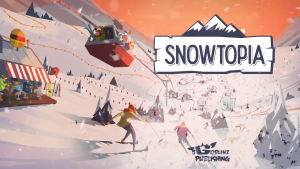
Snowtopia is a ski resort tycoon available in early access since 2021 and came out in 2022. The game allows players to shape their ski resort with a lot of freedom. It also has a singular twist in its in-game economy system: it does not include any money.
I had the opportunity to join the Snowtopia team in 2021 as a system game designer. I was in charge of adding depth to the management system of the game within its constraints by identifying points to improve, then finding solutions to do so.
I therefore worked on 3 main aspects :
The visitors used to have only criterias (slopes, food, aesthetics…) for the resort to meet for them to be satisfied. In order to give them a clearer goal and personalities (favorite places, foods etc), I designed a « list of activities » system for all the skiers’ profile. It was a simple solution to reinforce the reward of unlocking different profiles and to adjust difficulty easily by modifying how much they wanted to do in their stay and how hard it was for the player to get the facilities they liked. The list would be added to another, more passive systems of needs.
I created and balanced the list for all profiles, regarding their unlocking, targeted difficulty and in order to make the player discover several aspects of the game:

I also simulated the overall satisfaction, testing different formulas taking all aspects into account to balance the game closely to what it would be in-game.

In order to create a clearer behavior of the skiers, who were previously able to find « second best » solutions and therefore not send a clear sign to the player of why they were unsatisfied, I worked on their AI and their pathfinding.
I started by reworking what parts of the station they could see, regarding their ski level and the slopes at their disposal, taking all possibles situations into accounts.

Then I wanted to give them clear priorities on what they do, in order for the visitors to maximize their chances to be happy while being understood by the players. First with a simple flowchart, then a more detailled one, to help with programming integration.


In order to adjust the game difficulty dynamically, without overwhelming the players, 2 aspects needed to be tackled: each visitors end of stay and the spawn system of each type of visitors.
So I designed a flow for the end stay of visitors that felt fair for the players as well as a formula to ease each visitor type spawnrate, to avoid to overwhelm the players with too much skiers.


To conclude the clarification of the skiers’ needs and behaviors, I also worked on clarifying signs, feedbacks and the UI inherent to the skiers’ systems.
To achieve it, I started by rationalizing the different states the skiers could be in, and creating hierarchy between them in case they go off at the same time.

I also designed the UI to underpin the new designs for the skiers:


And suggested improvement for other UIs in the game, taking the large 3D map aspect of the game into account.


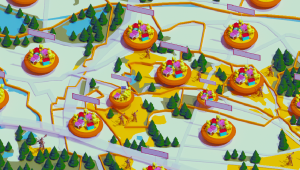
1001 rues is creating video games and softwares to guide land and town-planning based on democratic consultation.
I had the opportunity to work as a game designer on their biggest project yet, a turn-based city builder in which players can decide how they want to develop their cities and territory and experiment with the impacts of their choices. The main constraint was to find a balance between making it accessible to enhance the democratic aspect as well as sticking to the complex realities of urban-planning. I work alongside another designer on the concept and the overall first part of the project and I was in charge of the whole design on the second part.
My work can be split into 3 sections, regarding the 3 phases inside the game : the player makes choices, the system and its economy treats the changes and the players can observe feedbacks.
Please note that most of the work and details are under NDA.
The player has the possibility to place Cards to determine their actions and how they want to develop the city. This allows for a tangible way to act on the gameplay, reassuring non-players.

Each card has several parameters, in particular, they will affect one or several resources, positively or negatively and influence the city on the long-term. They will also take a certain number of turns. Cards can be a singular change (i.e. new building, new type of roads), a long-term change (i.e. promoting certain policies) or be applied on top of other ones in order to best stick to the town-planning realities.

I was in charge of the game’s economy and the simulation and reactions of the city. So I first listed all the possible resources that were first considered by the land-planners and that were interesting to take into account.
I arranged them to see how they could fit into categories such as primaries (influenced only by cards), secondary (influenced by cards and other resources) or tertiary (influenced only by other resources) and how they could be interconnected.

And well it was A LOT. So I worked on making them easier to deal with, both for the players as well as for the balancing phase.

I also prototyped bits of the simple economy in Machinations to find flaws before the Unity project was set.

One of the main challenge of this game is that the cities already exists. Usually when a players starts in a city builder, they start on a blank page, an empty land, in this case, they had to take into account the existing land and constructions.
We had 2 types of feedbacks, immediate building feedback once a Card’s turns are over and the system feedbacks, which indicate the long term effects a Card had on the city.
System feedbacks were a challenge because the game relies on what the player can experiment and learn from it in order to make enlighten choices. But some aspects of city-planning are hard to visualize without using too much UI (which was one of the constraints) such as health, education or social issues.
We therefore came up with several places to make feedbacks (Buildings, Roads, People and their thoughts and Global).